
Jee Tae-kwon, CEO of Semi-AI - Semiconductor Yield Managed by AI
[AI Infrastructure Efficiency Race ⑤]
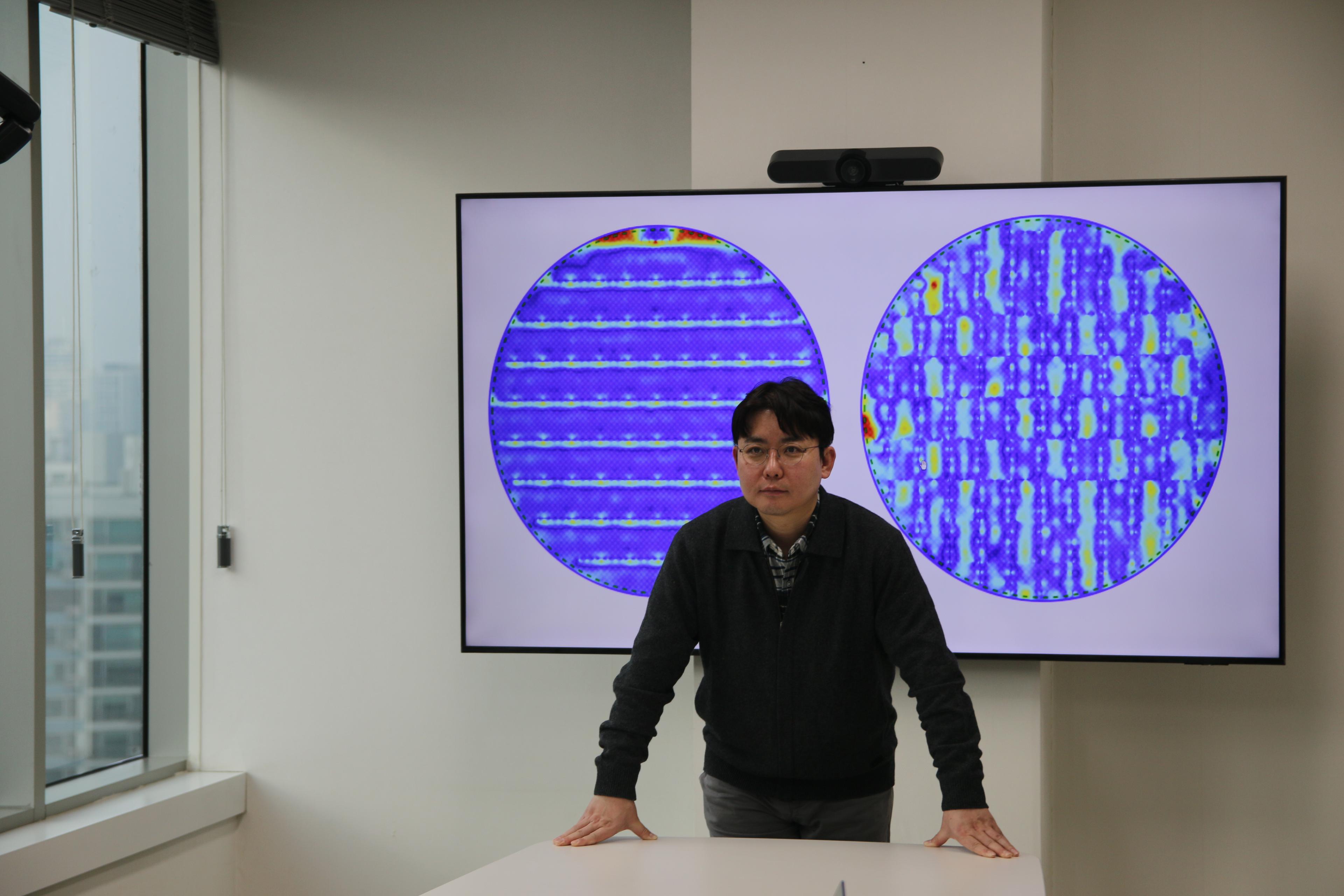
On a semiconductor manufacturing floor where more than 500 fine-grained processes and thousands of variables are intertwined, a 1% gap in yield translates directly into a gap in corporate profitability. As advanced semiconductors emerge and processes grow ever more complex, the conventional yield management approach—which has long relied on engineers' tacit expertise—has reached its limits. We visited SemiAI, a startup tackling this problem with artificial intelligence (AI). CEO Taekwon Jee argues, "We need a new approach: restructuring the entire process as a single system, and embedding AI as decision-making infrastructure." Drawing on Jee's frontline experience, this article explores the potential and practical value of intelligent semiconductor processes.
A single semiconductor chip only reaches completion after passing through more than 500 micro-processes. Layer upon layer of thin films are deposited on the wafer, patterns are etched, and metrology is performed. If even one variable goes off-spec, the overall yield (the share of normal products out of total production) wobbles. That is why detecting defects and identifying their root causes is so critical.
The problem is that for advanced semiconductors, the time and cost of tracing a defect's cause grow exponentially. As processes become more sophisticated, variables multiply and their correlations grow more complex. "As yield management becomes harder, the limits of an experience-driven approach are becoming clear," Jee said. "Even a 1% improvement in yield has an enormous impact on revenue and profitability." He added, "Now is the time to apply AI to yield improvement."
"Fortunately, the semiconductor industry has reached an environment where AI can finally be adopted in practice. In past manufacturing settings, the architecture of production management systems made large-scale data analysis technically difficult. Today, however, smart factory transformation, accumulated process and equipment data, and cloud-based infrastructure together provide a solid foundation for applying AI."
Against this backdrop, AI startup SemiAI is building a solution that uses AI to analyze the massive volume of data generated in semiconductor manufacturing and improve yield. Its flagship product is SMILE (Semiconductor Manufacturing Intelligence), an AI-based software for predicting defects and diagnosing root causes. SMILE's AI agents analyze sensor, equipment, and wafer data from semiconductor processes in a virtual environment in real time, identifying defect patterns and inferring causal relationships. According to Jee, SMILE compresses a yield analysis and improvement cycle that previously took more than seven days into less than ten minutes.
Given the strong interest in SMILE's capabilities, in February a delegation from the Williamson County Economic Development Partnership in Texas visited SemiAI's headquarters in Songpa, Seoul, and signed a Letter of Intent (LOI) for North American business expansion. A major Korean memory semiconductor company has also reportedly joined as a SMILE beta user, validating its applicability to actual production processes.
Founded in January last year, SemiAI is still an early-stage startup, but it has already established a U.S. subsidiary in Delaware and recruited an American Chief Strategy Officer. The reason: an increasing volume of proof-of-concept (PoC) discussions with U.S. semiconductor manufacturers. We sat down with Jee—who has accelerated SemiAI's global expansion in less than a year since founding—to hear about how to make semiconductor manufacturing more efficient, the technical architecture of SMILE, and the company's roadmap for global growth.
"It Took Years Just to Find a Single Defect"
"Improving the efficiency and reproducibility of semiconductor manufacturing simultaneously is the defining challenge of our era," Jee said. "To do that, the process of detecting defects and identifying their causes must also be systematized and made intelligent." In other words, repetitive experiments and decision-making must be automated.
"Even if we apply AI to semiconductor manufacturing in step with the times, it cannot remain a mere supplementary tool. Chip miniaturization and high-density integration will continue. Yield management will only get harder. We need to redesign AI as core infrastructure for process operations."
Jee's awareness of yield problems traces back to graduate school. As an Intel Fellow, he was responsible for analyzing the causes of defects in micro-patterns of 3D transistor processes and finding the conditions to improve them. "It took years to identify the root cause of a single defect," Jee said, "because the process of forming and verifying hypotheses depended heavily on individual engineers' skill."
Later, after moving to Lam Research, Samsung Electronics, ASML, and SK hynix, the situation did not change much. "In the etching process, while iterating to optimize conditions, the number of experiments an engineer could run in a day varied by two- or threefold depending on skill," he said. "I came to feel deeply that a structure where the speed of process improvement is governed by personal experience and intuition is embedded across the entire industry."
Ultimately, to resolve the frustrations he had felt for over a decade on the floor, Jee left SK hynix in May 2024. He then prepared the business as a solo founder for about six months. The reason he could plan business and technology design alone for so long was the yield-analysis methodology research he had conducted at his previous job, where he led R&D as a senior engineer on "co-optimization of memory semiconductor processes using machine learning, yield prediction, and yield enhancement."
He concluded that simply layering AI on top of an existing manufacturing environment would have inherent limits. Real efficiency gains, he believed, required process, equipment, and metrology data to be organically connected in an environment designed from the start with AI usage in mind. "This kind of approach was better suited to a form where you could experiment with new structures rather than try to do it incrementally inside an existing organization," Jee said. "I founded the company to create that independent environment." He has since focused on restructuring the entire process as a single system.
"Looking at Processes as a Line, Not a Point"
Conventional semiconductor process analysis solutions focus on detecting anomalies at specific stages, scrutinizing the segment where a defect occurs. But in advanced manufacturing environments where thousands of process steps are organically linked, optimizing individual segments alone has limits when it comes to lifting overall yield in a stable way.
SemiAI took a different approach. Architecturally, the company designed its system not to be tied to any single process. It analyzes the interactions between processes holistically, connecting yield-loss diagnosis to derivation of optimization conditions in a single flow. SemiAI also adopted a Human-in-the-Loop (HITL) structure: SMILE diagnoses the cause of a defect and proposes optimal process conditions for yield improvement, and the engineer makes the final judgment. AI is not a replacement for engineers but rather a collaborator supporting their decisions.
A virtual process environment is another core technology behind SMILE. Using real process data, SemiAI built a digital-twin-style virtual process model. The semiconductor industry strictly protects intellectual property (IP), making it difficult to use end-to-end process data in an integrated manner. "Beyond filling in segments where data sharing is restricted," Jee said, "we can even predict the likelihood of defects on products that haven't been directly measured."
SMILE goes a step further by attempting to reconstruct past process states—an approach that traces backward from a defect to find its root cause. By filling in missing or disconnected data points within the process flow, the system restores causal relationships, with multiple AI agents collaborating to complete the inference. On top of this, SemiAI has integrated a large language model (LLM)-based interface. Engineers don't need to handle complex code or formulas directly; they can query process data in natural language and review analytical results.
"Semiconductor manufacturing competitiveness is no longer determined by line-width shrinking alone," Jee said. "The efficiency of process operations and the speed of decision-making will determine the gaps between companies." That's also why he is pushing aggressively into the U.S. market. The demand for process-efficiency improvements is sharpest in environments with active new-fab construction and high labor and operating costs. SemiAI plans to secure multiple PoCs in the U.S. this year to validate the technology, and use that as a springboard for a Series A round. The strategy is not simple overseas expansion but to test and scale the technology within the decision-making structures of the U.S. semiconductor industry.
"My goal is to establish AI not as a process auxiliary tool, but as infrastructure," Jee said. "We need to create a structure where the process learns by itself." Combining technical validation and market expansion, building an AI operating system that can be applied on the semiconductor manufacturing floor is the next step SemiAI is sketching out.