
Approach to Validating Evidence for Yield Analysis AI Presented at SEMI Members Day 2026
Introducing a Vision for Autonomous Fab Analytics Through Data Integration and Hypothesis Revalidation
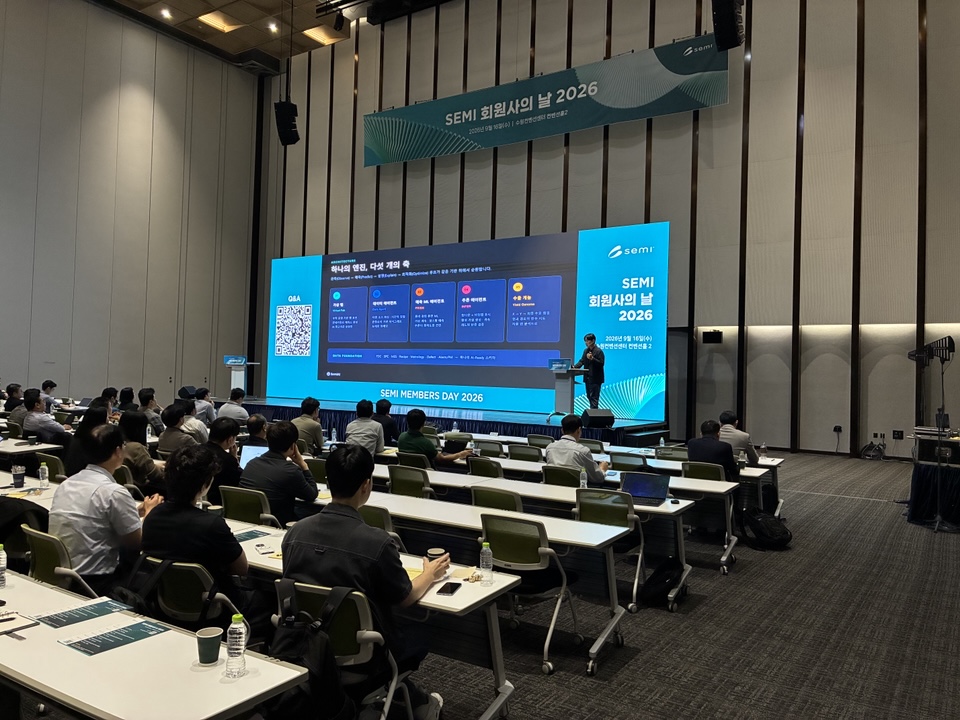
SemiAI CEO Taekwon Ji presents during the AI session at SEMI Members Day 2026
Taekwon Ji, CEO of semiconductor manufacturing artificial intelligence (AI) company SemiAI, presented an approach to using agentic AI to connect the causes of yield issues with supporting analytical evidence at SEMI Members Day 2026, held on September 16 in Convention Hall 2 at the Suwon Convention Center. In his presentation, “Using Agentic AI for Yield Prediction and Autonomous Fab Analytics,” Ji introduced an analytical framework that turns manufacturing data into accumulated knowledge engineers can verify.
SEMI Members Day brings together executives and employees of member companies to explore semiconductor market trends, technological changes, and business opportunities. This year’s program covered the outlook for the global semiconductor market and supply chain, AI technologies for manufacturing innovation, and trends in memory technology and the equipment and materials markets. Ji’s presentation was part of the manufacturing AI session, running from 2:35 p.m. to 3:05 p.m.
Ji identified the challenge on the fab floor as connecting causes and evidence across fragmented data. Although fabs accumulate equipment logs, process conditions, and metrology results, engineers must extract data, compare charts, and narrow down potential causes when yield excursions occur. He explained that the scope of analysis expands as process and equipment variables interact, while the hypotheses considered can differ according to each engineer’s experience.
The presentation proposed a collaborative architecture of AI agents with distinct roles as a solution. A data agent aligns timestamps and histories across different sources, while a prediction agent estimates process outcomes. A reasoning agent develops causal hypotheses from the analytical results. The core unit is a “synthetic proposition,” which records a hypothesis together with its evidence, confidence level, data sources, and links to supporting charts.
The process of challenging and revalidating analytical results was also emphasized. A separate red-team agent checks whether the same relationship appears across different time periods, whether conclusions hold when the data is stratified by chamber or recipe, and whether counterexamples or alternative explanatory variables exist. Validated propositions are stored with their source lineage and remain subject to further review. Failed hypotheses are also recorded for use in subsequent analyses.
The INFER reasoning agent combines two approaches: testing hypotheses proposed by engineers against the data and discovering new hypotheses from raw signals. Its output includes ranked potential causes, supporting evidence, and proposed next experiments. This approach is designed to allow engineers to trace the AI’s reasoning and verify it through additional measurements or experiments.
The PRISM prediction model incorporates semiconductor process knowledge and physical relationships. In the overlay prediction comparison presented by SemiAI, the root mean square error (RMSE) was 0.871 nm for linear regression, 0.488 nm for XGBoost, and 0.308 nm for PRISM. Overlay refers to the alignment between semiconductor layers, and a lower RMSE indicates a smaller prediction error. The company also stated that it is validating the same engine for tool-to-tool matching analysis and root cause analysis in photolithography processes.
As a long-term initiative, SemiAI presented the “Yield Genome” project. Its goal is to build a map of how equipment conditions and settings affect key process outcomes, and how those outcomes ultimately influence final yield. One of its foundations, the Virtual Fab, uses mathematical and physical models and probability distributions to generate various conditions, including drift and defects, allowing AI algorithms to be tested before actual wafers are used.
The presentation identified data integration and the accumulation of verifiable evidence for decisions as concrete tasks toward autonomous fab analytics. SemiAI outlined its direction of supporting engineers’ yield-improvement decisions through a feedback loop that expands the analytical context from equipment data to process outcomes and feeds validated hypotheses back into prediction and root cause analysis.