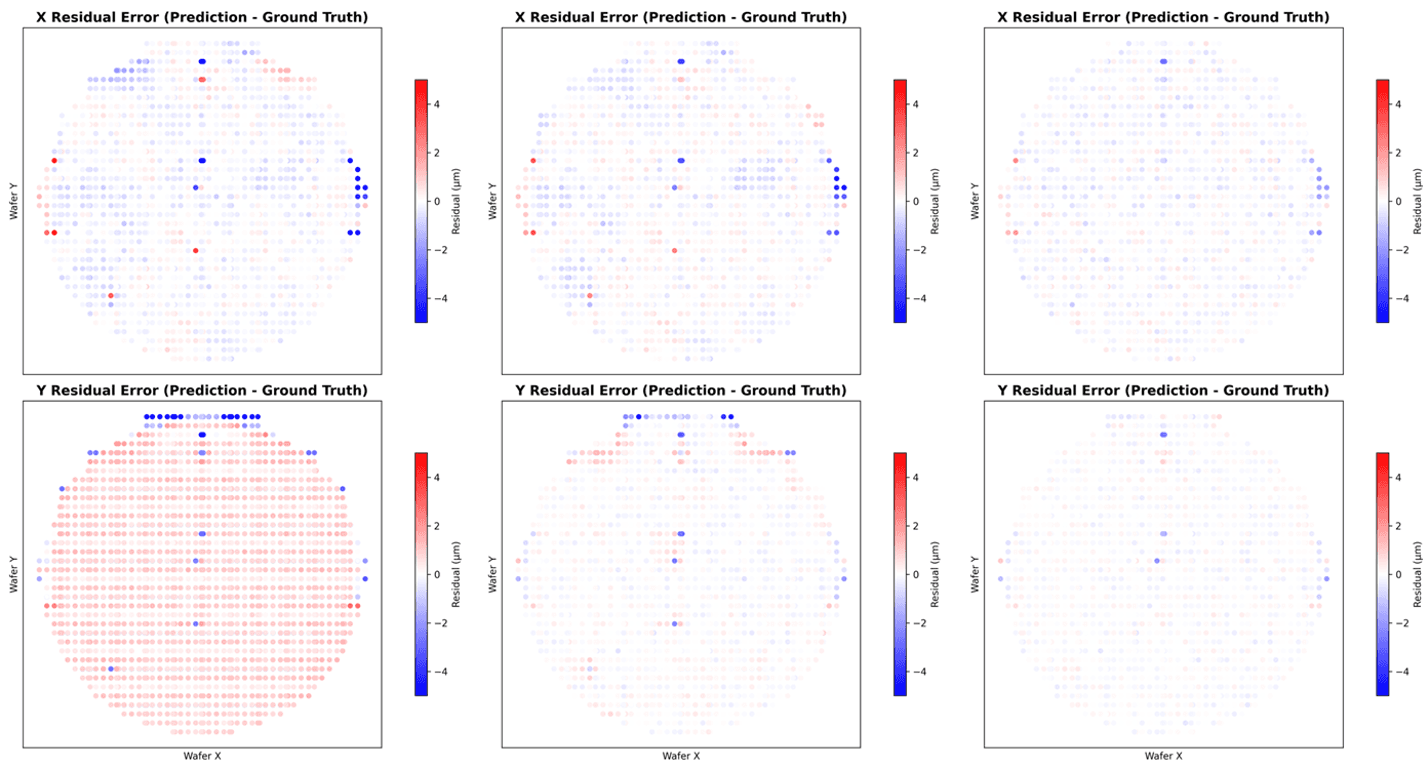
Among 3,000 Candidate Locations, Where Should You Measure?
Key Position Optimization for More Accurate Overlay Prediction with Fewer Measurements

The solution searches approximately 3,000 candidate locations for the optimal measurement combination. Its goal is to redesign the balance between measurement accuracy and production throughput.
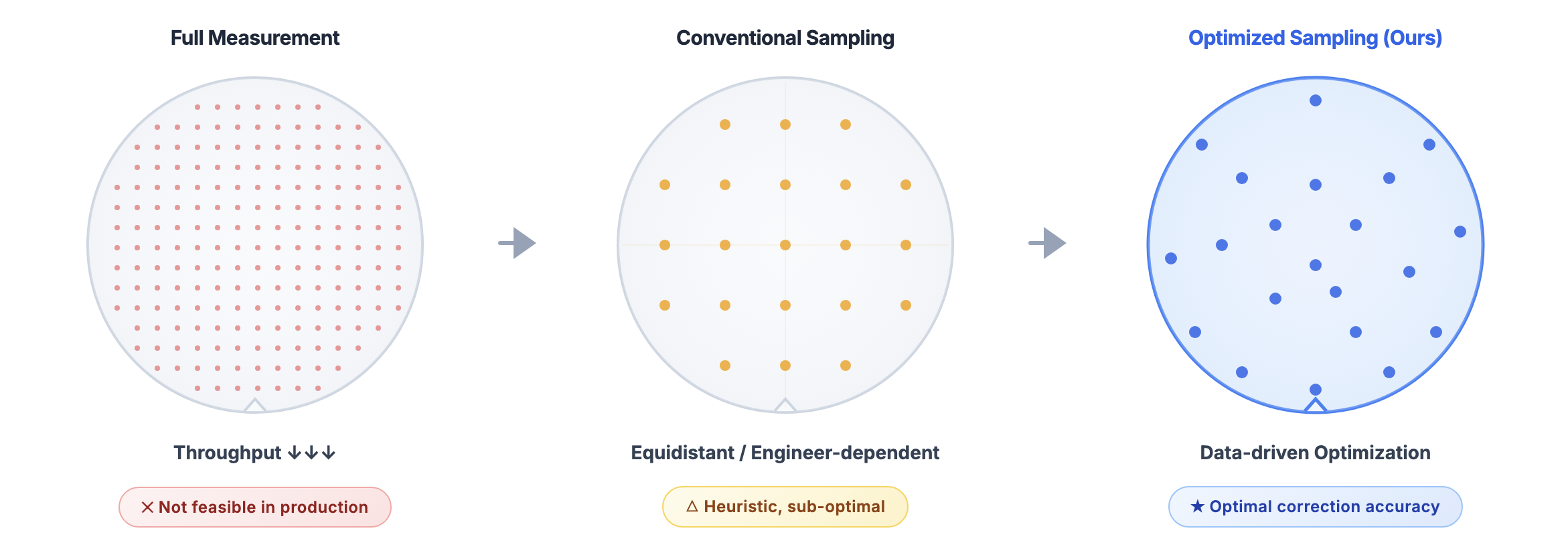
Can Measurement Points Be Reduced Without Sacrificing Predictive Performance?
In advanced semiconductor processes, overlay and edge placement error (EPE) tolerances are becoming increasingly stringent.
Measuring more locations can provide a more detailed understanding of the process, but full-wafer measurement significantly increases metrology-tool load and operating costs.
The key question in the fab is therefore simple: not “How much should we measure?” but “Where should we measure to capture the most information within a limited metrology budget?”
Turning Grid- and Experience-Based Selection into a Combinatorial Optimization Problem
Conventional approaches typically rely on equidistant grid placement, engineering experience, or sequential elimination using the Cascade method.
Cascade is fast and practical, but because it follows a greedy search—retaining the best choice at each step—it can become trapped in a local optimum as model complexity increases.
Choosing 32 positions from approximately 3,000 candidates yields nearly 10⁸⁰ possible combinations, a search space far beyond what human intuition or simple iteration can adequately explore.
SemiAI’s Approach: Combining Cascade Stability with the Search Power of a Genetic Algorithm
Sampling Optimizer uses a hybrid architecture that includes the baseline solution generated by Cascade in the initial population of a genetic algorithm (GA).
After establishing a stable starting point, it repeatedly applies selection, crossover, and mutation to explore a broader combination space.
This preserves the strengths of conventional methods while increasing the likelihood of finding a superior set of key positions.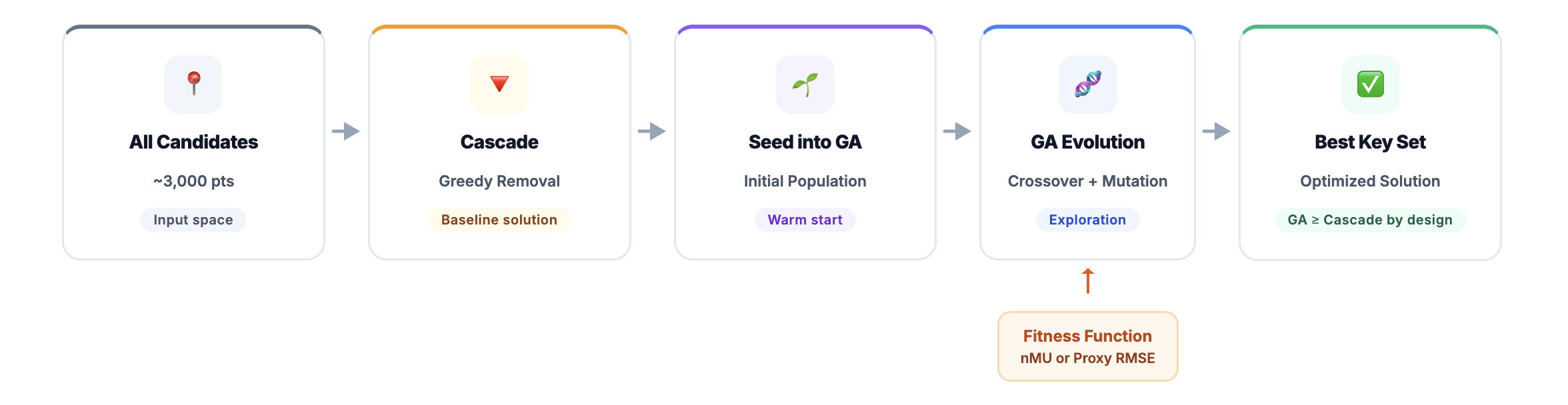
Figure 2. All candidates → Cascade baseline solution → GA search → Optimal key set | Source: SemiAI
| Technical Element | Practical Value in the Fab |
|---|---|
| Large-Scale Combinatorial Search | Efficiently uses GA to explore nearly 10⁸⁰ combinations created by selecting 32 positions from approximately 3,000 candidates |
| Warm Start | Includes the Cascade solution in the initial population so the search begins from a stable performance baseline |
| Flexible Fitness Function | Can use either nMU or an RMSE proxy that approximates actual overlay-prediction performance as the objective function |
| Offline Applicability | In experiments, GA averaged approximately 17 seconds versus about 5 seconds for Cascade—practical computational ranges for offline sampling-recipe optimization |
The Benefits of GA Became More Pronounced as Model Complexity Increased
In comparative experiments, GA achieved the lowest median score across all four nMU scoring methods. For the lower-order OVO model (6 parameters), Cascade alone delivered adequate performance.
However, the GA win rate reached 90% for OVO2 (19 parameters) and 100% for OVO3 (38 parameters), demonstrating that the benefits of global search expand as model dimensionality increases.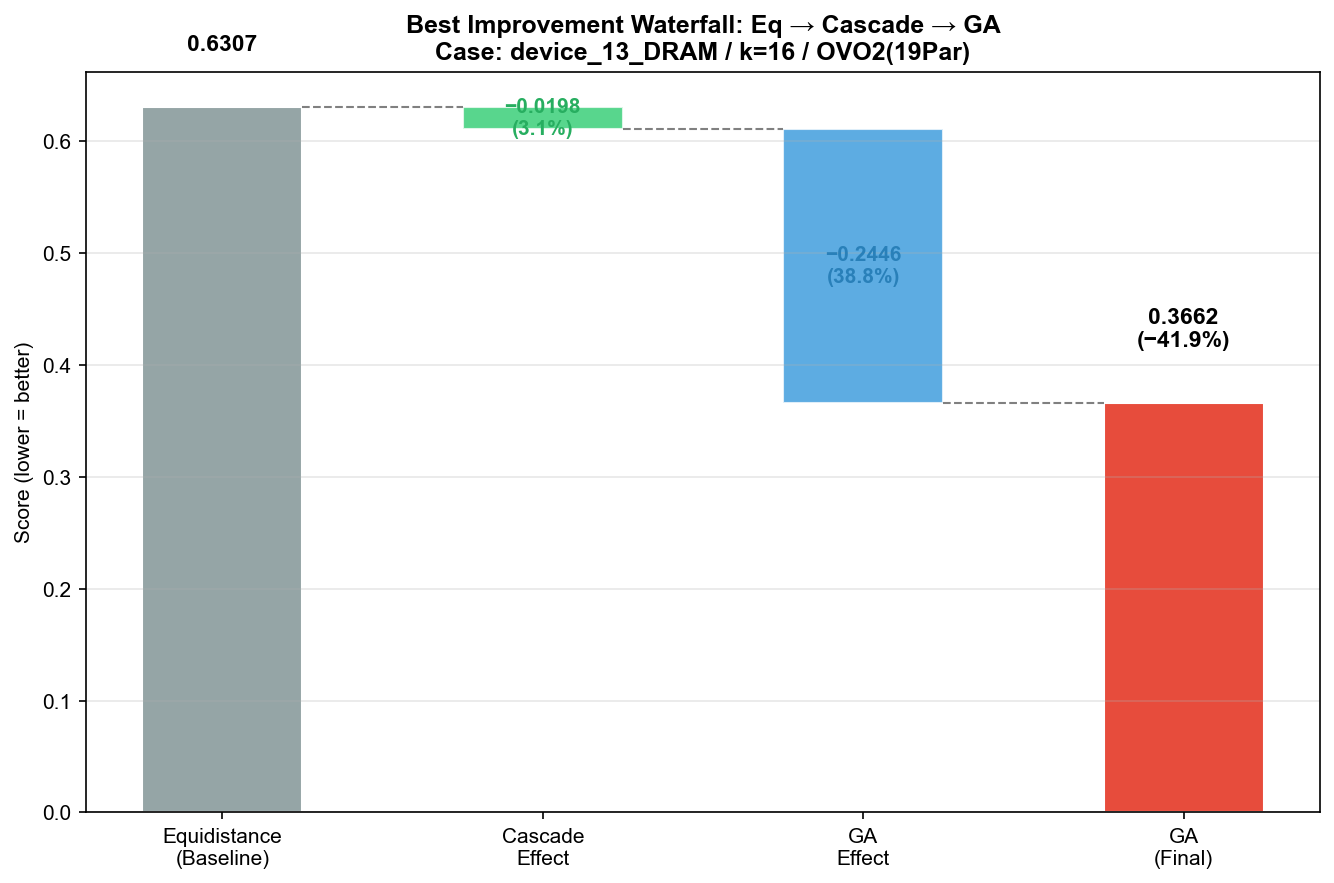
Figure 3. Best-performing test case (OVO2, Key 16): 41.9% improvement in the final score versus the equidistant baseline | Lower is better
What an Additional 12 Seconds of Search Revealed: 41.9% Improvement Potential
Under the best-performing test condition (OVO2, Key 16), Cascade improved the score by 3.1% versus the equidistant baseline.
GA delivered a further 38.8% improvement, resulting in a total score reduction of 41.9%.
This does not guarantee identical performance across every process.
It does, however, provide concrete evidence of the potential unlocked when measurement locations are systematically optimized for specific data and model conditions.
Even when the same number of points is measured, the amount of predictive information retained can vary depending on how those locations are selected.
The Value of Sampling Optimization in the Fab
The goal is not simply to reduce the number of measurements.
It is to identify the locations that best preserve predictive information within the same metrology budget.
Beyond nMU-based optimization, SemiAI proposes a framework that connects a proxy model—which rapidly approximates actual overlay-prediction RMSE—to the fitness function.
This makes it possible to design more precise sampling recipes for each process, product, and model while simultaneously managing metrology throughput.
The technology underlying Sampling Optimizer has been patented in Korea.
By combining semiconductor manufacturing data with domain expertise, SemiAI is transforming metrology strategy from experience-based selection into verifiable, data-driven decision-making.
Which locations are you measuring in your process today?
If you need stronger predictive performance within a limited metrology budget, we invite you to validate the opportunity with SemiAI.